If your business involves the use of chemicals, you’re bound to come across a safety data sheet (SDS) at some point. When that happens, it will be your legal and ethical responsibility to ensure that everyone on your team who will be working with an SDS-accompanied chemical is trained to do so safely.
With its first aid recommendations, hazard warnings, protective equipment guidance, and more, the SDS is your most valuable teaching tool for doing so.
In this article you’ll find a plain-language explanation of the contents of an SDS, along with some background and context on the subject.
What is a Safety Data Sheet?
In 2003, the United Nations (UN) adopted the Globally Harmonized System of Classification and Labeling of Chemicals (GHS). The GHS includes criteria for the classification of health, physical, and environmental hazards, as well as specifying what information should be included on labels of hazardous chemicals as well as the Safety Data Sheets (SDSs) previously known as Material Safety Data Sheets (MSDSs).
OSHA (Occupational Safety and Health Administration) published a proposed rulemaking on September 30, 2009 to align OSHA’s Hazard Communication Standard (HCS) with the GHS by 2012. The GHS requires all owners of the SDS to conform to a specific format of thirteen mandatory sections and three non-mandatory sections organized in a certain order.
An SDS is a detailed document required by OSHA’s Hazard Communication Standard (HCS) 1910.1200 and Lab Safety Standard 1910.1450 to accompany any hazardous chemical. It conveys critical information for the safe handling and use of the chemical, as well as how to respond to the various hazards it poses.
The SDS may come from the manufacturer as a hard copy or in digital format, either before the chemical shipment arrives or with the chemical order. You may elect to keep it in either format, but whichever you choose, the SDS must be readily available to your workers in the work area, not locked up or put behind a password on a computer.
If for some reason the SDS has not been sent with a chemical, you should be able to download it from the manufacturer’s website or request a copy directly.
What Chemical Products Require an SDS?
Any chemical whose manufacturer has determined qualifies under the HCS definition as “hazardous”–meaning it represents a physical or health hazard–requires a safety data sheet.
To determine this, the manufacturer should conduct a hazard evaluation. For example, drugs are potentially hazardous chemicals, so pharmaceutical companies should always conduct a hazard evaluation for their products.
Other types of products that typically have an SDS include:
- solvents
- lubricants
- paints
- cleaners
- sealants
- compressed gasses
- fuels
Although SDSs are not intended for consumers, home products that contain hazardous chemicals may be of interest to members of the public seeking information about a product’s manufacturer, composition, hazards for the people who work with it, etc.
Understanding a Safety Data Sheet
An SDS can seem daunting to read, but it can be broken down into a handful of objectives outlined below:
Sections 1–3: Identifying the Chemical and Understanding its Safety Risks
The first few sections of the SDS are intended to make clear what product the handlers are dealing with and what potential dangers they face if something goes wrong. You’ll also learn the manufacturer’s contact information and details about the chemical itself, such as its CAS Registry Number, name, formula, weight, recommended use, and composition concentration (which may be withheld as a trade secret).
Sections 4–6: Dealing with Emergencies
With the potential hazards laid out, the SDS now tells you what to do should any of those hazards become a reality. Sections 4 and 6 detail first aid measures and clean-up measures in the event of a spill, respectively, while Section 5 is intended for use by firefighters.
Sections 7–11: Preventing Hazardous Situations
This is where you’ll learn how to safely handle the chemical, what equipment to use and wear, and more detail about the chemical’s properties—including exposure limits, PPE requirements, and reactivity information.
Sections 11 & 12: Health and Environmental Effects
Here the SDS reiterates the health implications of the chemical and its immediate, delayed, and chronic effects. Section 12, while not mandatory, covers what happens if the chemical is released into the environment.
Sections 13 & 14: Disposal and Transport
Whether you need to dispose of the chemical or transport it, you’ll find guidance here, often referencing relevant state or federal rules.
Sections 15 & 16: Additional Information
Section 15 makes room for other regulatory bodies that oversee the chemical. Section 16 typically shows the latest revision date and a disclaimer regarding the accuracy of the SDS.
Is an SDS All That Chemical Products Require?
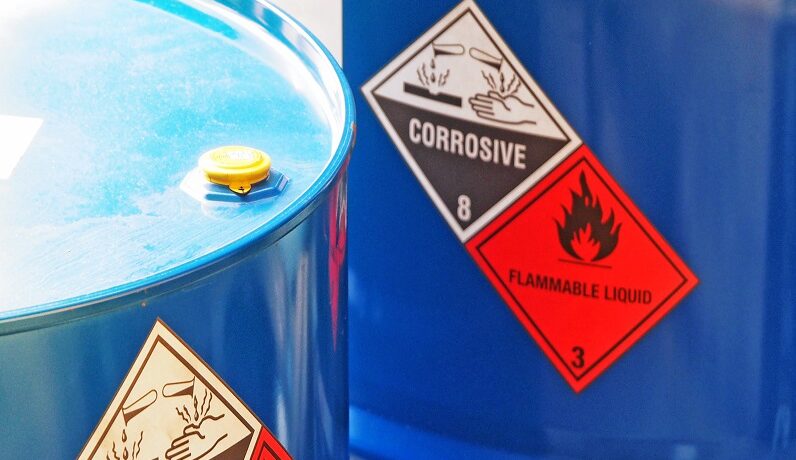
If it originated outside the U.S. or is sold internationally, a chemical product may also carry a GHS label—the United Nations’ unified system for streamlining chemical hazard identification worldwide. OSHA’s latest SDS requirements have been updated to sync with the GHS, identifying key info such as the manufacturer/supplier, hazard pictograms and statements, and signal words like “warning” or “danger.”
Unichem is Experienced in Creating & Maintaining SDSs
Unichem provides a turnkey solution for a given chemical product, including hazardous chemicals, from proof of concept through to manufacturing, packaging, and shipping.
We create and maintain a comprehensive library of SDSs so that our customers and anyone downstream who comes into contact with our hazardous chemicals has the information they need to stay safe.